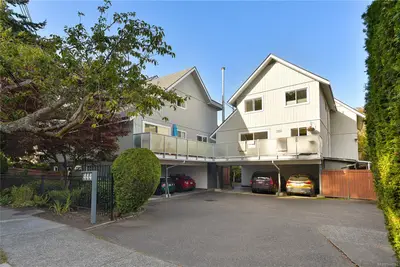

Condos make up a significant share of Victoria's resale market, from downtown Victoria to Oak Bay, Langford, and Saanich. They're often the most accessible price point for first time buyers and investors alike. But buying a strata property involves a layer of due diligence that freehold purchases don't.
Here's what to review before you make an offer on a condo in Greater Victoria. New to the process? Our home buyer's guide for Victoria covers the full journey from pre-approval through to closing day.
The Form B: Your Starting Point
Every strata corporation in BC is required to provide a Form B Information Certificate when requested by a unit owner. When you're buying, your agent requests it on your behalf as part of your subject conditions.
The Form B confirms the current monthly strata fees, any special levies owing on the unit, whether the unit has outstanding bylaw violations, and the current balance of the Contingency Reserve Fund. It also discloses whether any legal proceedings are underway involving the strata corporation. Read it carefully before subject removal.
For more on what's in the Form B and how strata governance works in BC, see the IslandSold Strata Guide.
The Contingency Reserve Fund
The CRF is the strata corporation's savings account for major repairs and replacements. Roof, elevators, windows, parkade membrane, building envelope. When the CRF is underfunded, one of two things happens: a special levy or deferred maintenance.
A healthy CRF typically holds 25% or more of the estimated cost to replace major components. The Form B shows the current balance. The depreciation report shows what's coming and what it will cost.
There's no hard rule on what “enough” looks like because it depends on the building's age, condition, and what's already been done. Your agent should help you read these numbers in context.
Depreciation Reports
BC strata corporations with 5 or more lots are required to obtain a depreciation report every 5 years. As of July 2024, new provincial regulations removed the ability for strata corporations to waive depreciation reports by owner vote, so current reports will become the standard going forward.
The report lists every major common property component, its estimated remaining life, and the projected replacement cost. It also outlines funding models to show whether the current contribution level is adequate.
Red flags to watch for in a depreciation report:
- Components listed as end of life with no repair or replacement scheduled
- A CRF that falls below the recommended level within the next 5 years
- A report that's more than 5 years old with no update
Building Age and the Leaky Condo Era
Buildings constructed between roughly 1982 and 1998 in BC carry elevated risk due to construction methods common during that period. Flat roofs, no overhangs, face sealed stucco, and OSB sheathing created conditions for water ingress that caused widespread building envelope failures across the province.
This doesn't mean all buildings from that era are problems. Many have had full envelope remediations and are in excellent condition. But you need the documentation: engineering reports, remediation history, current warranty coverage, and an up to date depreciation report.
Buildings from that era are often priced lower to reflect the history. Buyers willing to do the diligence can find value, provided the work has been done properly.
Strata Fees and Your Mortgage Math
Strata fees are included in your total monthly housing cost for mortgage qualification purposes. On a $600,000 condo with $450 per month in strata fees, the lender treats that $450 as a fixed obligation when calculating your debt service ratios.
Practically, that means strata fees reduce your purchase ceiling. A buyer qualifying for $700,000 on a freehold property may qualify for $620,000 to $650,000 on a condo with $500 per month in strata fees, depending on income and other debts.
Ask for the strata fee schedule upfront. Also ask whether any special levies have been approved but not yet collected. Those won't appear on the Form B until formally levied.
Dollar values above are illustrative. Mortgage qualification depends on your income, debts, lender, and current rate environment. Speak with a mortgage broker for figures specific to your situation.
Subjects on a Strata Purchase
A standard offer on a strata property in Victoria includes subjects for financing, home inspection, and strata document review. The strata documents package includes the Form B, current bylaws and rules, meeting minutes for the past 2 years, the depreciation report, strata plan, and insurance certificate.
Your subject period is typically 5 to 10 business days. The strata document review is done by you and your agent, though buyers purchasing in older buildings sometimes bring in a strata review service.
Pay attention to the meeting minutes. They reveal ongoing disputes, deferred maintenance items, owner complaints, and any discussions about upcoming special levies. Minutes tell you what the Form B doesn't.
What the Prepared Buyer Program Means for Condo Buyers
If you're buying a condo in Victoria with the Prepared Buyer Program, the same structure applies: pre-approval in hand, exclusive agreement in place, specific property identified. The Premium returned to you at completion ranges from $6,000 to $10,000 depending on the fee structure offered by the seller.
Frequently Asked Questions
Do I need a home inspection on a condo?
Yes. A home inspection on a condo covers the interior of the unit: plumbing, electrical, HVAC, windows, and appliances. It doesn't cover common property. For older buildings, some buyers also commission a building envelope assessment or review engineering reports from previous repairs.
Can I get the strata documents before making an offer?
You can ask. If the listing agent has them available, you may be able to review them before writing. More often, strata documents are provided after an accepted offer during your subject period. Your agent can request them from the listing agent as part of the offer process.
What is a special levy and how do I know if one is coming?
A special levy is a one time charge to all strata owners to cover a specific expense the CRF can't absorb. The Form B shows any levies formally approved. The meeting minutes show discussions about upcoming work that could lead to one. The depreciation report shows what major expenditures are projected over the next 30 years. None of these sources is exhaustive on its own.
Are strata fees negotiable?
No. Strata fees are set by the strata corporation and apply equally to all owners of equivalent units. What's negotiable is the purchase price. Buyers sometimes factor anticipated fee increases or upcoming levies into their offer.
What happens if the strata has ongoing litigation?
The Form B discloses pending legal proceedings involving the strata corporation. Active litigation can affect your financing: some lenders won't approve mortgages on stratas with significant pending claims. Ask your agent and mortgage broker before subject removal if anything is disclosed.
Strata regulations, depreciation report requirements, and qualification rules are subject to change. Work with a licensed BC real estate agent and a lawyer or notary before making any decisions.
Buying a condo in Victoria?
The Prepared Buyer Program gives you $6,000 to $10,000 back at completion on a typical Victoria condo purchase. The qualification assessment takes about two minutes.