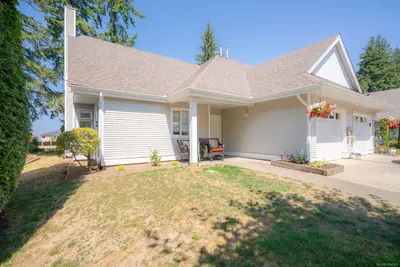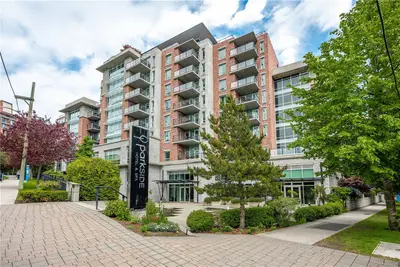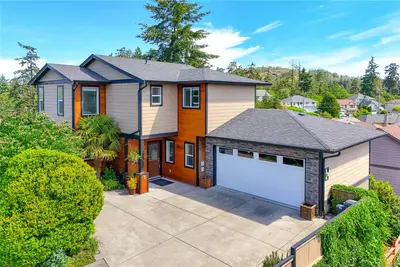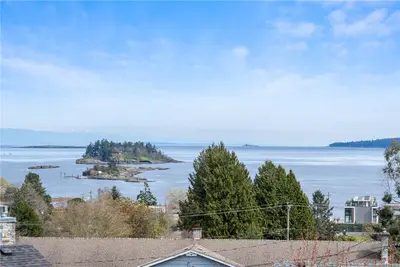
Vancouver Island's real estate market in early 2026 is defined by rising inventory, stable prices, and cautious buyers navigating tariff uncertainty and interest rate shifts. Here is what the latest data from VREB, BCREA, CMHC, BC Assessment, and the Bank of Canada tells us about where the market stands and where it is heading.
Last updated: February 19, 2026. All statistics sourced from official reports with numbered footnotes below.
Key Market Numbers at a Glance (January 2026)
| Metric | January 2026 | Year Over Year |
|---|---|---|
| Properties Sold (Victoria Region) | 339 | Down 19.7% from 422 [1] |
| Active Listings (Victoria Region) | 2,624 | Up 9.6% from 2,395 [1] |
| Single Family Benchmark (Victoria Core) | $1,265,500 | Down 2.5% from $1,297,300 [1] |
| Condo Benchmark (Victoria Core) | $537,800 | Down 1.5% from $545,900 [1] |
| Bank of Canada Overnight Rate | 2.25% | Down from 5.0% peak in June 2024 [2] |
| Vancouver Island Assessed Property Value | $399 billion | Up from $391 billion in 2025 [3] |
Sales Activity: Slower Start, But Context Matters
The Victoria Real Estate Board reported 339 properties sold in January 2026, a 19.7% decline from 422 sales in January 2025 and a 7.6% drop from 367 sales in December 2025.[1] Single family home sales fell 21.1% year over year, and condo sales declined 25.3%.[1]
VREB Chair Fergus Kyne noted that sales patterns are "similar to 2023 and 2024, returning to seasonal norms after the pandemic era," with the key difference being "much more inventory on the market."[1]
Across all of Vancouver Island, over 15,000 residential properties sold in 2025 at a median price of $799,000, with an average of 98 days on market.[8] The strongest months for volume were July (1,657 sales) and August (1,585 sales), while January and February were the slowest, which follows normal seasonal patterns.[8]
Prices by Area: Where Vancouver Island Stands
Prices vary dramatically across Vancouver Island's micro markets. Here is a snapshot of median sold prices from 2025 sales data alongside current active inventory:
| Area | Median Sold Price (2025) | Avg Days on Market | Active Listings |
|---|---|---|---|
| Saanich East | $1,150,000 | 92 days | 270 |
| Colwood | $950,000 | 129 days | 79 |
| Saanich West | $975,000 | 85 days | 91 |
| Sooke | $829,000 | 109 days | 187 |
| Parksville, Qualicum | $825,000 | 96 days | 310 |
| Langford | $789,900 | 99 days | 425 |
| Comox Valley | $774,250 | 99 days | 339 |
| Nanaimo | $729,000 | 100 days | 559 |
| Duncan | $717,000 | 101 days | 404 |
| Victoria | $685,000 | 89 days | 364 |
| Campbell River | $654,950 | 104 days | 200 |
| Port Alberni | $577,000 | 113 days | 235 |
Source: MLS® data via VREB and VIREB board feeds.[8] Median sold prices based on residential sales from January to December 2025. Active listings as of February 2026.
Property Types: What Buyers Are Paying
Across Vancouver Island in 2025, single family homes accounted for 8,602 sales at a median price of $975,000 with an average of 98 days on market.[8] Condos (3,229 sales) had a median price of $525,000 and averaged 110 days on market.[8] Townhouses (1,915 sales) landed at a median of $699,900, and half duplexes (480 sales) at $725,000.[8]
For buyers looking at current active inventory, asking prices are higher than recent sold prices, which reflects sellers testing the market. Active single family listings have a median asking price of $1,129,750, while condos sit at $524,900 and townhouses at $718,400.[8]
Inventory: The Biggest Shift in Years
The defining feature of the 2026 market is inventory. Victoria's active listings reached 2,624 in January 2026, up 9.6% from 2,395 a year earlier.[1] Across the full island, more than 4,200 residential properties are actively listed.[8]
BCREA reports that active listings across BC are at their highest levels in over a decade, exceeding 40,000 province wide.[4] This gives buyers significantly more selection and negotiating power than they have had since the pre pandemic market.
Fergus Kyne described the market as hovering "at the threshold between balanced and buyer's market territory," emphasizing that "diverse micro markets across the Victoria region behave differently."[1]
Interest Rates: Where They Stand
The Bank of Canada held its overnight rate at 2.25% at the January 28, 2026 announcement.[2] This follows a significant easing cycle from the peak of 5.0% in June 2024. The rate has been at 2.25% since the October 2025 cut.[2]
Key factors from the Bank of Canada's January 2026 statement:[2]
- Inflation near the 2% target, with CPI at 2.4% in December 2025
- Core inflation around 2.5%, down from 3% in October 2025
- GDP growth projected at 1.1% for 2026, 1.5% for 2027
- US tariff threats and CUSMA review identified as major uncertainty factors
- Next rate decision: March 18, 2026
Most major banks are holding prime rates at 4.45%, which translates to variable rate mortgages in the low to mid 4% range and five year fixed rates in the mid 4% range depending on the lender and qualification.[2]
BC Assessment: Property Values Holding Steady
The 2026 BC Assessment roll, released January 2, 2026, valued Vancouver Island properties at a total of $399 billion, up from $391 billion in 2025. About $4.71 billion of that increase came from new construction, subdivisions, and rezoning rather than market appreciation.[3]
Most homeowners saw changes between negative 5% and positive 5%. Here is how Greater Victoria municipalities performed:[3]
- Victoria, Saanich, Oak Bay, Central Saanich, North Saanich: up 1% to 2%
- Sidney: up approximately 2%
- Langford, Esquimalt: flat (no significant change)
- View Royal, Colwood: down approximately 1%
- Sooke: down approximately 1%
- Metchosin: down approximately 2%
- Highlands: down approximately 3%
Assessments reflect market value as of July 1, 2025, so they lag behind current conditions by about seven months.[3]
BCREA Forecast: 12% Sales Rebound Expected in 2026
The BC Real Estate Association's Q1 2026 Housing Forecast projects 78,690 MLS® residential sales province wide in 2026, a 12% increase over the 70,250 units sold in 2025.[4] The average BC home price is forecast at $982,800, up 3.1% from $953,314 in 2025.[4]
For Vancouver Island specifically, BCREA forecasts:[4]
- Victoria region: sales up 4.5%, prices up 2.2%
- Vancouver Island Board (mid and north island): sales up 5.7%, prices up 3.6%
BCREA Chief Economist Brendon Ogmundson characterized the outlook as a "slow return to normal," noting that "many markets are now returning to long run average sales activity and should head into 2026 with some momentum."[4]
CMHC: Housing Starts Trending Lower
The CMHC Housing Market Outlook for 2026 projects declining housing starts across BC.[5] Key takeaways for Vancouver Island:
- New home construction expected to trend lower in 2026, following strong apartment activity in 2025[5]
- Condominium presales have declined significantly in Victoria, stalling many planned projects[5]
- Rental apartment construction, which has been strong due to policy incentives, is expected to slow in the second half of 2026 as vacancy rates rise and rent growth slows[5]
- National housing starts forecast at 247,000 for 2026, down from 259,000 in 2025[5]
For the resale market, CMHC expects Victoria's sales activity to "recover modestly in 2026" supported by low interest rates and buyer urgency ahead of possible rate adjustments in 2027.[5]
Policy Changes Affecting Vancouver Island in 2026
BC Budget 2026 Impacts
The 2026 BC Budget introduced several changes that affect real estate on Vancouver Island:[6]
- Speculation and Vacancy Tax increased to 4% for foreign owners (effective January 1, 2026)[6]
- School taxes on development lands increased[6]
- PST now applies to housing related professional services[6]
BCREA criticized these measures, with Ogmundson warning they "will raise development costs and hinder project viability" and could be "self defeating" for housing supply goals.[4]
Property Transfer Tax (Unchanged for 2026)
BC's Property Transfer Tax rates remain the same for 2026: 1% on the first $200,000, 2% on $200,001 to $2,000,000, 3% on $2,000,001 to $3,000,000, and 5% above $3,000,000 for residential properties.[7]
First time home buyers receive a full exemption on properties under $835,000 and a partial exemption between $835,000 and $860,000. Newly built homes receive a full exemption under $1,100,000.[7]
Density Legislation
BC's SSMUH legislation (Bill 44) and Transit Oriented Areas (Bill 47) continue to reshape development potential across Vancouver Island, allowing up to 4 to 6 units on single family lots without rezoning and mandating higher density near transit hubs.
What This Means for Buyers and Sellers
For Buyers
- More inventory means more selection and more negotiating power than any point since 2019
- Interest rates at 2.25% are dramatically lower than the 5.0% peak, improving purchasing power
- Days on market averaging 90 to 110 days means there is less pressure to make rushed decisions[8]
- Entry level options exist: condos at a median of $525,000, manufactured homes at $322,450[8]
For Sellers
- Pricing accuracy is critical in a market with 9.6% more competing listings[1]
- Properties that are well prepared and correctly priced are still selling within normal timeframes
- The spread between asking prices and sold prices suggests some sellers are testing the market above where buyers are transacting
- The BCREA forecast of modest price growth (2.2% for Victoria, 3.6% for the broader island) suggests stability rather than significant appreciation[4]
Want detailed market data for your area?
View real time market analytics for Greater Victoria neighbourhoods, including median prices, days on market, and inventory trends.
View Market AnalyticsSources
- [1] Victoria Real Estate Board (VREB), January 2026 Market Statistics, released February 2, 2026. vreb.org/current-statistics
- [2] Bank of Canada, Policy Interest Rate Announcement, January 28, 2026. bankofcanada.ca
- [3] BC Assessment, Vancouver Island 2026 Property Assessments, released January 2, 2026. bcassessment.ca
- [4] BC Real Estate Association (BCREA), Q1 2026 Housing Forecast Update. bcrea.bc.ca/economics/housing-forecast
- [5] Canada Mortgage and Housing Corporation (CMHC), Housing Market Outlook 2026, February 2026. cmhc-schl.gc.ca
- [6] Province of British Columbia, 2026 BC Budget Tax Updates. gov.bc.ca/taxes/tax-updates/budget-changes
- [7] Province of British Columbia, Property Transfer Tax Rates. gov.bc.ca/taxes/property-taxes/property-transfer-tax
- [8] IslandSold.com MLS® database, aggregated from VREB and VIREB board feeds (IDX data), February 2026. islandsold.com/market-analytics