What Are Transit-Oriented Areas?
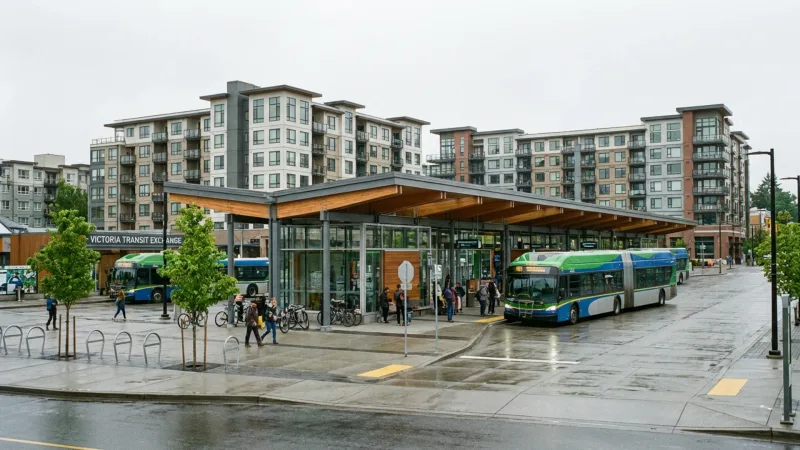
Transit-Oriented Areas (TOAs) are designated zones within 400 metres of major transit exchanges where the province requires municipalities to allow significantly higher-density residential and mixed-use development. The core idea is straightforward: areas with the best public transit access should have the most housing, because residents in those locations can rely on transit instead of private vehicles.
Unlike SSMUH rules that apply broadly across Greater Victoria, TOAs target specific locations where transit infrastructure already exists, creating focused pockets of higher-density development opportunity. Our SSMUH vs Transit-Oriented Areas comparison explains the key differences between these two frameworks.
For property owners near designated transit exchanges on Vancouver Island, TOA legislation represents a fundamental change in what their land can support. Properties that were limited to a single-family home may now have the potential for mid-rise residential or mixed-use development, dramatically increasing their land value and development options.
Bill 47 Explained
Bill 47, the Housing Statutes (Transit-Oriented Areas) Amendment Act, is the provincial legislation that establishes the TOA framework. Passed alongside Bill 44 in November 2023 as part of BC's comprehensive housing legislation package, Bill 47 requires municipalities to allow higher-density development near designated transit exchanges.
Key elements of Bill 47 include:
- Transit exchange designation: The province designates specific transit exchanges as TOA hubs based on transit service frequency, ridership, and regional significance. Each exchange triggers TOA requirements for properties within 400 metres.
- Two-tier density requirements: Properties within 200 metres of the exchange must allow up to 10 storeys. Properties between 200 and 400 metres must allow up to 6 storeys. These are provincial minimums, and municipalities can allow more.
- Parking minimums eliminated: Municipalities cannot impose minimum residential parking requirements within TOA zones, except for accessible parking. This dramatically changes the economics of development.
- Mixed-use encouraged: Ground-floor commercial uses may be encouraged or required in the innermost tier to support walkable, transit-oriented neighbourhoods.
- Municipal compliance: Municipalities must update their zoning bylaws and Official Community Plans to accommodate TOA density. Like Bill 44, municipalities cannot use public hearings to block TOA-compliant developments.
Bill 47 is designed to work in coordination with Bill 44 (SSMUH) and BC Transit's regional service plans. As transit service improves and ridership grows, additional exchanges may be designated as TOA hubs, expanding the areas where higher-density development is mandated.
Designated Transit Exchanges on Vancouver Island
Eleven transit exchanges on Vancouver Island are designated under TOA legislation, spanning two regions:
Greater Victoria Region (7 exchanges)
UVic Exchange (University of Victoria)
Located in Saanich, the UVic Exchange is one of the busiest transit hubs in Greater Victoria, serving over 17,000 daily passengers across 14 routes with 21 transit bays. Properties within 400 metres of the exchange are now subject to TOA density requirements, creating significant development potential in the Gordon Head area. The surrounding area includes established single-family neighbourhoods with larger lots, proximity to the University of Victoria campus, nearby Royal Jubilee Hospital, and existing commercial services along Shelbourne Street and Cedar Hill Cross Road.
Uptown Exchange (Saanich)
Located near the Uptown Shopping Centre in Saanich, this exchange serves as a major transfer point for routes connecting downtown Victoria to the Western Communities and Saanich. The surrounding area already features mid-rise commercial development, and TOA designation accelerates residential density. The Uptown area benefits from its central location between Victoria, Oak Bay, and the Westshore, making it a natural candidate for high-density, transit-oriented development.
Royal Oak Exchange (Saanich)
A key transit hub in Saanich connecting north-south corridors. The Royal Oak area features a mix of commercial and residential properties that are now positioned for higher-density redevelopment under TOA rules. The exchange's proximity to the Patricia Bay Highway provides regional accessibility, while the surrounding residential lots offer substantial redevelopment potential.
Langford Exchange
The primary transit hub for the fast-growing Western Communities. Langford has been one of the fastest-growing municipalities in the Capital Regional District, and the exchange anchors transit service for the Westshore. Langford's rapid population growth and existing commercial development around the exchange, combined with a pro-development stance and streamlined permitting process, may make this one of the first areas to see substantial TOA development.
Colwood Exchange
Serving the Colwood and West Shore corridor, this exchange connects commuters to downtown Victoria and other Western Communities. TOA designation around the exchange opens up density on lots that were previously restricted to single-family zoning, complementing Colwood's broader growth plans.
View Royal Exchange
A transit hub linking View Royal to the broader Greater Victoria network along the Trans-Canada Highway corridor. Properties near this exchange benefit from TOA density allowances in an area that has seen steady residential and commercial growth.
Legislature Exchange (Downtown Victoria)
The central transit hub adjacent to the BC Legislature and Inner Harbour. While downtown Victoria already permits higher density, the TOA designation removes remaining barriers and parking minimums for residential development in the surrounding area.
Nanaimo Region (4 exchanges)
Country Club Exchange
Central Nanaimo transit hub near the Country Club Mall area.
Woodgrove Exchange
North Nanaimo hub near the Woodgrove Centre, one of Vancouver Island's largest shopping centres.
VIU Exchange (Vancouver Island University)
Serves the university campus and surrounding residential areas in central Nanaimo.
Downtown Nanaimo Exchange
The commercial core transit hub for downtown Nanaimo and the waterfront area.
Density Tiers by Distance
For bus exchanges outside Metro Vancouver (which includes all Vancouver Island TOAs), the provincial density minimums are structured in two tiers around each designated exchange:
| Distance from Exchange | Maximum Height | Floor Area Ratio (FAR) |
|---|---|---|
| Within 200 metres | Up to 10 storeys | Up to 3.5 FAR |
| 200 to 400 metres | Up to 6 storeys | Up to 2.5 FAR |
These are minimum requirements, and municipalities can choose to allow even greater density. The key takeaway is that properties within 400 metres of a designated exchange must be permitted for significantly more development than traditional single-family zoning would allow. Beyond 400 metres from the exchange, properties fall under standard SSMUH density allowances under Bill 44.
For a property owner within 200 metres of the UVic Exchange, for example, a standard single-family lot that was previously limited to one home plus a secondary suite could now potentially support a 10-storey, 3.5 FAR development. A property between 200 and 400 metres could support a 6-storey, 2.5 FAR development. Our guide to assessing development potential in Victoria, BC walks through how to evaluate these opportunities.
Parking Minimums Eliminated
One of the most impactful provisions of Bill 47: municipalities cannot impose minimum residential parking requirements within TOA zones, except for accessible parking. This is not a reduction, it is an elimination.
This single provision dramatically changes the economics of development near transit exchanges:
- Construction cost savings: Underground parking can cost $50,000 to $80,000 per stall. Eliminating the requirement to build it can reduce per-unit costs by tens of thousands of dollars.
- More buildable area: Without parking requirements consuming ground-floor or underground space, more of the building footprint can be used for housing.
- Smaller-scale viability: Mid-rise projects on smaller lots become financially feasible when they are not required to accommodate expensive structured parking.
- Transit use encouraged: Reduced parking supply encourages residents to use the transit service that justified the TOA designation in the first place.
Developers may still choose to include some parking based on market demand, but the decision is market-driven rather than mandated. Bicycle parking requirements are typically maintained or increased in TOAs, and developers are often encouraged to provide car-share spaces and electric vehicle charging stations.
Municipalities Required to Designate TOAs
Seven Vancouver Island municipalities, plus Lantzville, are required to comply with TOA legislation:
- Victoria — Legislature Exchange
- Saanich — UVic Exchange, Uptown Exchange, Royal Oak Exchange
- Langford — Langford Exchange
- Colwood — Colwood Exchange
- View Royal — View Royal Exchange
- Nanaimo — Country Club, Woodgrove, VIU, Downtown exchanges
- Lantzville
Each municipality must update its zoning bylaws and Official Community Plan to accommodate the density required under TOA legislation. Like Bill 44, municipalities cannot use public hearings to block TOA-compliant developments within the designated zones.
Interaction with SSMUH
TOA legislation works alongside, and in addition to, the Bill 44 density rules that govern SSMUH across Greater Victoria. In practice:
- Properties outside both TOA and SSMUH zones follow existing municipal zoning
- Properties in SSMUH areas (but outside TOAs) can build up to 4 units, or up to 6 units near frequent transit bus service
- Properties within TOA zones get the highest density allowances, up to 10 storeys within 200 metres and up to 6 storeys within 200 to 400 metres
- Where SSMUH and TOA overlap, the more permissive standard applies
This creates a graduated density model across the region: gentle density in standard residential areas (SSMUH), moderate density along frequent transit corridors, and significant density near designated transit exchanges (TOAs). The two frameworks are complementary, not conflicting. You will want to assemble the right team of development consultants to move from analysis to execution on any TOA project.
Impact on Property Values
TOA designation has a significant and often dramatic impact on property values, particularly for lots closest to transit exchanges.
Land value uplift
When a property transitions from single-family zoning (one house) to TOA zoning (potentially a 10-storey building within 200 metres), the land value can increase by a factor of 2 to 5 or more. A lot that was worth $900,000 as a single-family site might be worth $2 million to $4 million as a development site in the inner tier of a TOA. The actual uplift depends on the specific density permitted, the size of the lot, servicing availability, and development potential.
Assembly premiums
Larger development sites command higher per-square-foot land values because they can accommodate more efficient building designs with better unit mixes and lower per-unit construction costs. When multiple adjacent lots in a TOA are assembled into a single development site, the combined value is typically greater than the sum of the individual lot values. This assembly premium creates opportunities for property owners who coordinate with neighbours to sell together.
Timing considerations
Property values in TOAs will increase gradually as development activity grows. Early sellers may not capture the full long-term value of their land, while holding too long risks missing the window when developers are actively assembling sites. The optimal timing depends on your personal circumstances, the pace of development in your area, and broader market conditions.
Tax implications
Rising property values in TOAs may lead to higher property tax assessments. BC Assessment evaluates properties based on their highest and best use, which may now include multi-storey development potential. Homeowners concerned about rising assessments should review their assessment notices carefully and consider applying for the provincial homeowner grant, which can offset some of the increase.
Development Timeline
TOA development will unfold over a multi-decade horizon, but the early stages are already underway. Here is a realistic timeline for what to expect:
Near term (2024-2027)
Municipal bylaw updates to implement TOA density requirements. Early development applications on vacant or underutilized lots. Speculative land purchases by developers looking to assemble sites. Initial infrastructure planning and DCC reviews. Property assessment increases for lots in inner tiers.
Medium term (2027-2032)
First wave of completed TOA developments (typically 3 to 5 years from application to occupancy for larger projects). Increased land assembly activity. Infrastructure upgrades (sewer, water, roads) to support higher density. Transition of some single-family lots to redevelopment sites. Growing demand for pre-development development consultants (architecture, engineering, surveying).
Long term (2032 and beyond)
Mature TOA neighbourhoods with a mix of housing types and commercial uses. Transit service improvements driven by increased ridership from higher-density development. Second and third waves of development filling in remaining sites. Established market values for TOA properties based on demonstrated development economics.
For individual property owners, the timeline for your specific lot depends on its location within the TOA, lot size, the pace of development activity around you, and your personal circumstances. There is no rush, TOA designations are permanent, and your development potential does not expire.
Frequently Asked Questions
What are Transit-Oriented Areas (TOAs)?
Transit-Oriented Areas are designated zones within 400 metres of major transit exchanges where the province mandates higher-density development. Established by Bill 47, TOAs require municipalities to allow taller buildings and more housing units near frequent transit hubs. The goal is to concentrate housing where public transportation is most accessible, reducing car dependency and making better use of existing transit infrastructure.
Which transit exchanges on Vancouver Island are designated as TOAs?
Eleven transit exchanges on Vancouver Island are designated under TOA legislation. In Greater Victoria: UVic Exchange (Saanich), Uptown Exchange (Saanich), Royal Oak Exchange (Saanich), Langford Exchange, Colwood Exchange, View Royal Exchange, and Legislature Exchange (downtown Victoria). In Nanaimo: Country Club Exchange, Woodgrove Exchange, VIU Exchange (Vancouver Island University), and Downtown Nanaimo Exchange. Seven municipalities, plus Lantzville, are required to comply.
How tall can buildings be in a Transit-Oriented Area?
Building height depends on the distance from the transit exchange. Within 200 metres, buildings of up to 10 storeys are permitted with a Floor Area Ratio (FAR) of up to 3.5. Between 200 and 400 metres, buildings of up to 6 storeys are permitted with a FAR of up to 2.5. These are provincial minimums for bus exchanges outside Metro Vancouver, and municipalities can choose to allow even greater density.
How far from a transit exchange do TOA rules apply?
TOA regulations apply to properties within 400 metres of a designated transit exchange. There are two tiers: within 200 metres (highest density, up to 10 storeys) and 200 to 400 metres (up to 6 storeys). Beyond 400 metres, properties fall under standard SSMUH density allowances under Bill 44.
What happens to parking requirements in TOAs?
Municipalities cannot impose minimum residential parking requirements within TOA zones, except for accessible parking. This is one of the most impactful provisions of Bill 47, because underground parking can cost $50,000 to $80,000 per stall. Eliminating parking minimums dramatically reduces construction costs, allows more buildable area on constrained lots, makes smaller-scale developments financially viable, and encourages transit use.
How do TOAs affect property values near transit exchanges?
Properties within TOA boundaries have generally seen significant value increases, particularly those closest to exchanges. A single-family lot that was valued at $800,000 as a residential site could be worth $2 million or more as a development site if TOA regulations allow a 10-storey building. However, the actual value depends on the specific density permitted, lot size, construction costs, market demand, and the timeline for development.
When will TOA development actually happen?
TOA development is already underway in some areas and will unfold over 10 to 20 years across most designated exchanges. The first projects tend to be on vacant or underutilized lots where assembly is not required. Over time, as property values rise to reflect development potential, more owners will sell to developers or develop their own properties. The pace depends on market conditions, interest rates, construction costs, and the speed of municipal permitting.
Can I still live in my single-family home in a TOA?
Yes. TOA regulations change what can be built on a lot, but they do not require you to sell or redevelop. If you own a single-family home within a TOA, you can continue to live in it for as long as you choose. The TOA designation may increase the value of your property because a developer could build more on it, but there is no obligation to sell or develop. You can also explore SSMUH options on your lot while continuing to live there.
Do TOAs apply to properties on all sides of a transit exchange?
Yes. TOA regulations apply in all directions from the designated transit exchange, creating a roughly circular zone of density around the exchange. However, the actual development pattern may not be perfectly circular because of natural features (parks, waterways, steep terrain), existing infrastructure, and land ownership patterns. Roads, highways, and other barriers can also affect which properties are practically accessible from the exchange within the 400-metre walking distance.
How does Bill 47 interact with Bill 44 and SSMUH?
Bill 47 (TOAs) and Bill 44 (SSMUH) work together but apply at different scales. Bill 44 provides baseline density across residential areas, up to 4 units per lot, or up to 6 units near frequent transit bus service. Bill 47 provides enhanced density near designated transit exchanges, up to 10 storeys within 200 metres and up to 6 storeys within 200 to 400 metres. Where both apply, the more permissive standard takes precedence. Properties outside TOA boundaries but within urban areas are still subject to SSMUH requirements under Bill 44.
What infrastructure improvements are needed for TOA development?
Higher-density development near transit exchanges requires upgrades to water and sewer capacity, stormwater management, electrical infrastructure, road networks and pedestrian infrastructure, parks and community facilities, and the transit service itself. The province and municipalities share responsibility for these upgrades. Development Cost Charges (DCCs) and Community Amenity Contributions (CACs) from developers help fund infrastructure improvements.
Are there any exemptions from TOA requirements?
Limited exemptions exist for properties with environmental constraints (floodplains, environmentally sensitive areas), heritage-designated buildings or properties, Agricultural Land Reserve lands, and areas where servicing infrastructure is fundamentally inadequate. However, the province has been clear that municipalities cannot use these exemptions broadly to avoid implementing TOA density requirements. The intent is that exemptions are narrow and site-specific, not area-wide.
Can municipalities allow more density than the provincial minimums?
Yes. The provincial TOA requirements are minimums, not maximums. Municipalities can choose to allow greater density, taller buildings, or more permissive zoning than what the province requires. The legislation sets a floor, not a ceiling, for development near transit exchanges.