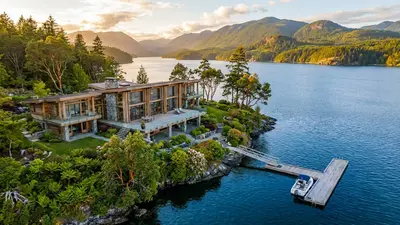
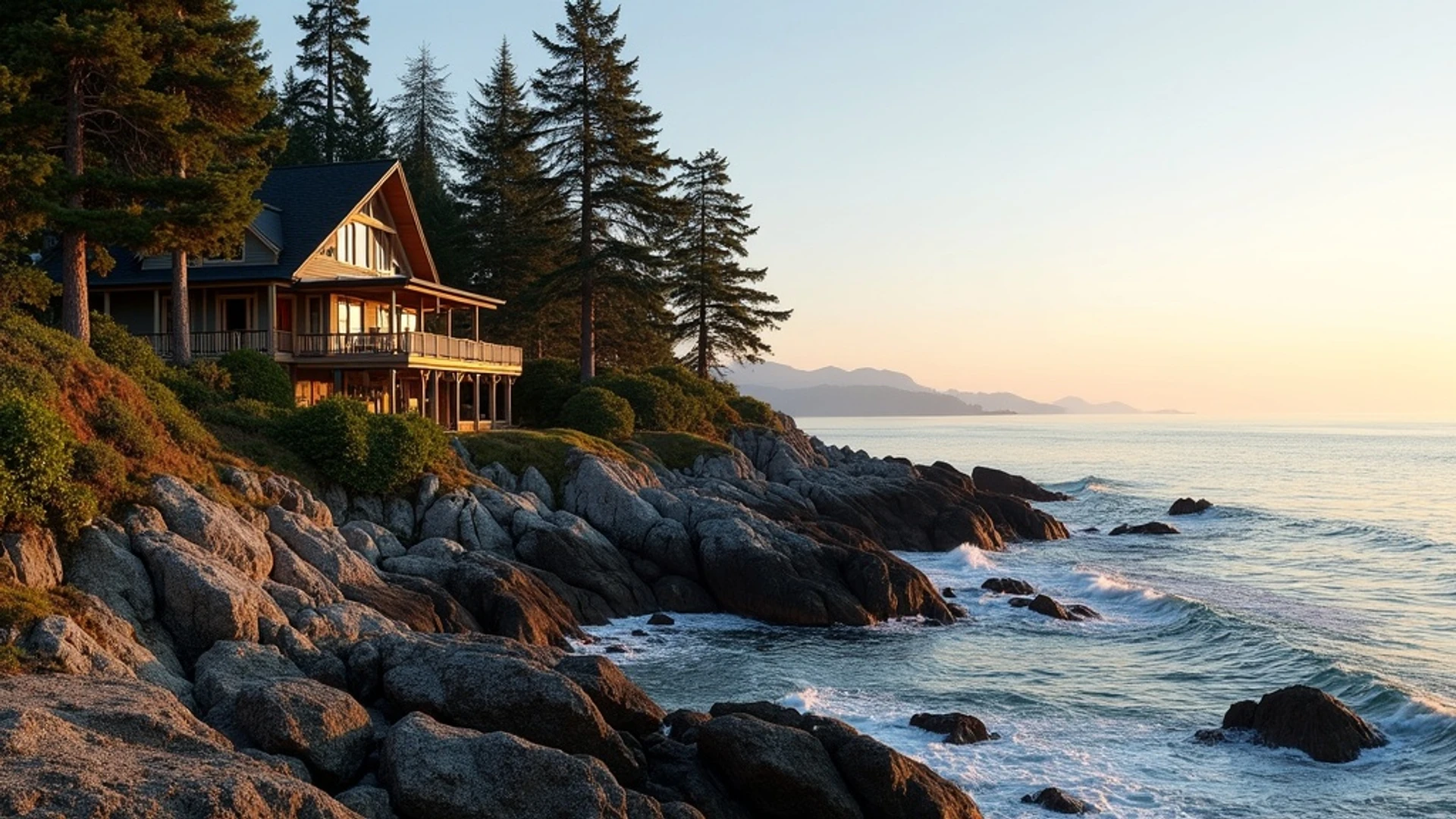
Vancouver Island has more than 3,400 kilometres of coastline, plus dozens of inland lakes and rivers. That means “waterfront” covers a wide range of property types, price points, and due diligence requirements. Ocean view, direct ocean access, lakefront, riverfront: each comes with its own regulatory layer, title structure, and process before you can build, dock, or even clear brush. This guide covers what you need to know before writing an offer on any waterfront property on the Island.
Ocean Waterfront vs Lakefront: The Core Difference
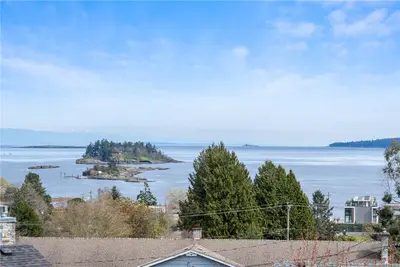
Ocean waterfront properties on Vancouver Island fall into two camps: those on protected water (harbours, inlets, sheltered bays) and those on open Pacific exposure. Protected water is calmer, warmer in summer, and typically easier to build a dock on. Properties in Sidney, Oak Bay, and Brentwood Bay sit on sheltered marine water. Open exposure properties along the Strait of Juan de Fuca or the west coast offer dramatic views but require significant wave mitigation in construction and ongoing maintenance.
Lakefront is a different product. The most active lake markets on the Island are Lake Cowichan, Shawnigan Lake, Sproat Lake near Port Alberni, and Thetis Lake on the outskirts of Victoria. Lake properties are generally more affordable than ocean waterfront, and the recreational season is longer because inland lakes are warmer for swimming. Lakefront in the Cowichan Valley shows a median near $1.3M across waterfront-flagged active and recent sales (n=132), with cabin-style lots and older structures available below that and newer builds with full road access and services reaching $14.5M at the upper end.
Foreshore Leases and Crown Land Below the Tide
The most important title question on any oceanfront purchase is what the registered title actually includes. In British Columbia, the foreshore (the strip of land between the high tide mark and the low tide mark) is Crown land by default under the Land Act, RSBC 1996, c. 245. Most oceanfront properties include fee simple title only to the natural boundary (the high tide mark). Everything seaward of that belongs to the Province.
To place a dock, float, boathouse, or any structure on the foreshore or in the water, the owner needs a Crown land tenure document from the Province, administered by BC’s Ministry of Water, Land and Resource Stewardship. There are two common types: a licence of occupation (for smaller or temporary structures) and a foreshore lease (for permanent structures like boathouses). Both have terms (typically 10 years) and are renewable, but renewal is not guaranteed and is subject to changed conditions or First Nations consultation requirements.
When a property sells, an existing foreshore lease does not automatically transfer with the title. The new owner must apply to the Province to have the tenure transferred or assigned, and some older tenures are non-transferable and require a new application from scratch. A new application can take 6 to 18 months and carries no guarantee of approval. Before removing subjects on any oceanfront purchase with a dock or float, confirm: whether a valid tenure document exists, its expiry date, whether it is transferable, and what structures are authorized under it. Your conveyancing lawyer must review this separately from the fee simple title search.
A dock present on a property with no foreshore tenure is an unauthorized encroachment on Crown land. The Province can order its removal at any time, and the cost of removal falls on the landowner. Listing agents are not always aware of the tenure status of a dock, so do not assume the presence of a dock means the paperwork is in order.
Archaeological Sensitivity and the Coastal Record
Vancouver Island’s coastline contains one of the densest concentrations of First Nations archaeological sites in Canada. Shell middens (the compressed remains of thousands of years of coastal habitation) are present at thousands of locations along the Island’s shores, many of them unmarked on any public map and not registered on title. Under BC’s Heritage Conservation Act, RSBC 1996, c. 187, all archaeological sites are protected by law regardless of land ownership, including unregistered and previously unknown sites. Disturbing an archaeological site without a permit is a provincial offence carrying fines of up to $50,000 for an individual.1
For waterfront buyers, this matters in two practical ways. First, any development or site alteration near the water (a new septic system, a deck addition, a retaining wall, or removal of soil for landscaping) may require an Archaeological Impact Assessment (AIA) as a condition of the municipal development or building permit. The AIA is prepared by a professional archaeologist registered with the BC Association of Professional Archaeologists, and the cost typically runs $3,000 to $15,000 or more depending on the scope of the assessment and whether field work is needed.
Second, if archaeological material is discovered during any construction or excavation, work must stop immediately and BC’s Archaeology Branch must be notified. Failure to stop can result in fines and project suspension. Some discoveries result in the site being registered and permanently protected, which can constrain future development on the property. Buyers should ask the local municipality whether any previous archaeological assessments have been done on a property and search the BC Archaeological Site Registry before finalizing a purchase on coastal land.
It is also worth knowing whether the property sits within the traditional territory of a specific First Nation and whether that Nation has asserted any interests in the site. Municipalities in BC are increasingly required to consult with First Nations as a condition of issuing permits, and an oceanfront property with known archaeological sensitivity may face longer permit timelines regardless of what the title search shows.
Fishing Rights, DFO Authorization, and Riparian Access
There is a common misconception among buyers that owning waterfront land confers special fishing rights. In Canada, the fish in navigable and tidal waters belong to the Crown and are managed federally by Fisheries and Oceans Canada (DFO) under the Fisheries Act, RSC 1985, c. F-14. Buying a property on the water does not grant commercial fishing rights, and the recreational fishing licences available to BC residents apply regardless of whether you own waterfront property.
What waterfront ownership does convey, under common law riparian doctrine, is the right of access to the water, the right to use the adjacent water for reasonable purposes including private recreational fishing, and the right to an unobstructed view and natural flow. These are not statutory rights and can be affected by foreshore tenure conditions, municipal zoning, or specific registered covenants on title. Some First Nations on Vancouver Island hold constitutionally protected fishing rights under Section 35 of the Constitution Act, 1982, in areas adjacent to their traditional territories, which can affect development approvals near fisheries but does not affect recreational fishing access for property owners.
The more significant issue for buyers planning any water-related improvements is the Fisheries Act. Under Section 34.4 (as amended by the Fisheries Act amendments of 2019), any work in, on, near, or around water that could cause serious harm to fish or fish habitat requires DFO review and, in many cases, formal authorization before construction begins.2 This covers dock construction or modification, shoreline armoring, dredging, removal of riparian vegetation, and any in-water work below the high tide mark. DFO authorization is separate from the Province’s foreshore tenure process: a buyer can have a valid foreshore lease from the Province and still require a DFO authorization before building the dock. Both must be in hand before construction begins.
Some waterfront properties on the Island are adjacent to DFO-designated fish habitat areas or sit near salmon-bearing streams that enter the ocean nearby. In these cases, the DFO review is more intensive and the conditions attached to an authorization can limit what structures are permitted, require specific construction timing windows (outside of salmon migration periods), and mandate mitigation measures. Buyers planning any waterfront improvements should consult with a qualified environmental professional before committing to a purchase, particularly on properties where the shoreline has not been modified in recent years and the riparian vegetation is intact.
Lakefront Regulations: Riparian Setbacks and Dock Permits
Lakefront properties carry their own regulatory framework, distinct from the ocean foreshore system but no less complex. The primary instrument in BC is the Riparian Areas Regulation (BC Reg 109/2004) under the Fish Protection Act. The RAR establishes protected setback areas from the natural boundary of lakes, streams, and wetlands, within which development is restricted to protect fish habitat and water quality. The exact setback is not a fixed number: it must be determined by a Qualified Environmental Professional (QEP) through a Riparian Areas Assessment (RAA), which the local government requires before issuing a building permit for any new structure or significant addition near the water.3
In practice, a lakefront buyer who wants to build a new cabin, add a deck, replace a septic system, or construct a dock needs a QEP assessment before the municipality will issue a building permit. The assessment process takes weeks to months depending on the complexity of the site and the availability of qualified professionals. Budget $2,000 to $8,000 for the assessment alone, before any permit or construction costs.
The natural boundary of a lake, which is the legal starting point for the riparian setback, is the high water mark as established by survey or historical record, not the shoreline as it appears on a low water day. On lakes with fluctuating water levels, like Shawnigan Lake, the natural boundary can sit well above the current waterline, meaning a structure that appears to be comfortably set back from the water may actually fall within the riparian setback area.
Dock permits on BC lakes generally require two separate approvals: a Shoreland Tenure from the Province (the lake equivalent of an oceanfront foreshore lease), and local government approval under the municipality’s zoning and building bylaws. DFO review applies to lake docks as well, since most lakes on Vancouver Island support fish habitat. Buyers should not assume that a dock visible on a property is permitted, as many older lakefront docks predate the current regulatory framework and were installed without formal tenure. Unpermitted docks create the same risk as unpermitted oceanfront structures: the Province can require removal at the owner’s cost.
Vegetation removal within the riparian setback area is also regulated. Clearing trees, removing native vegetation to create a lawn to the water’s edge, or grading the bank are all site alterations that can trigger RAR enforcement regardless of whether a building permit has been applied for. Municipalities and the Province can issue stop-work orders and restoration orders for unauthorized vegetation removal in riparian areas.
Sources
- Heritage Conservation Act, RSBC 1996, c. 187, BC Laws
- DFO Fisheries Protection Program, Fisheries and Oceans Canada
- Riparian Areas Regulation, BC Reg 109/2004, BC Ministry of Environment and Climate Change Strategy
- Crown Land Tenures, BC Ministry of Water, Land and Resource Stewardship
- BC Archaeology Branch, Province of British Columbia
What Waterfront Costs on Vancouver Island in 2026
The following ranges come from active and sold MLS listings on IslandSold.com filtered to confirmed waterfront properties (boolean waterfront = true), April 2025 to April 2026. Sample sizes (n) are noted — areas with small samples should be interpreted with caution.
- North Saanich protected ocean waterfront: median $3.73M (n=43), ranging from around $1M for entry-level waterfront access to over $12M for large estate properties with private dock. The high median reflects the concentration of deep-water frontage and executive acreage in this area.
- Sidney harbour and marine waterfront: median $1.39M (n=26), ranging from $479K for strata units with water access to $5.5M for single family ocean frontage. Sidney’s protected harbour makes it the most accessible ocean waterfront market on the Saanich Peninsula.
- Oak Bay ocean frontage: the waterfront sample is small (n=15) and includes one significant outlier. General Oak Bay detached homes median $1.80M (n=196) with the premium end reaching $7.5M — oceanfront properties command a substantial premium above those figures. Treat Oak Bay waterfront pricing as highly site-specific.
- Parksville and Qualicum oceanfront: median $900K across 166 waterfront-tagged listings (land-only parcels excluded from this description). Improved residential waterfront properties typically run $500K to $3.5M, with strong retirement buyer demand supporting consistent activity at the $700K to $1.5M range.
- Sooke and west coast exposure: median $900K (n=111, land parcels excluded). Effective range for improved properties is $500K to $2.5M. The lower per-front-foot price reflects higher construction and ongoing maintenance costs due to wave exposure and salt air.
- Comox Valley waterfront: median $998K (n=112), ranging from under $500K for smaller lots and strata access to $4.95M for premium homes with dock. Well-sheltered marine water and strong boating infrastructure.
- Campbell River sheltered water: median $1.0M (n=49), ranging from $285K to $3.4M. Discovery Passage access and established marina infrastructure.
Lakefront data from the same period: Lake Cowichan and the broader Cowichan Valley show a waterfront median of $1.27M (n=132), ranging from $211K for raw lakefront land to $14.5M for large estate properties. Shawnigan Lake and the Malahat area show a waterfront median of $1.70M (n=44), ranging from $325K for cabin-style lots to $9M for premium lakefront homes.
Prices based on active and sold MLS listings via IslandSold.com, April 2025 to April 2026, waterfront-flagged properties only. Data reflects asking and sale prices; individual properties vary. Land-only parcels excluded from prose ranges.
Insurance and Financing Considerations
Waterfront properties can be harder to finance and insure than inland homes. Lenders typically require higher down payments on recreational or non primary residence waterfront: 20% minimum, often 25 to 35% for rural or island access properties. Insurance on properties with direct wave exposure or older roofing and siding can be expensive and in some cases requires a specialist marine or coastal insurer.
Flood maps maintained by BC Emergency Management show flood risk zones, and some oceanfront properties in low lying areas may require separate flood coverage as a condition of insuring with a standard carrier. If the property runs on a well and septic rather than municipal water and sewer, budget for a water test and a recent septic inspection, as lenders will often require both as conditions of financing.
Which Water Type Fits Your Goals
Ocean waterfront buyers are drawn to the view, the permanence of salt air and sunsets, and the infrastructure of a marine access property: a dock, a kayak route, proximity to marinas and ferry terminals. The best ocean waterfront areas for year round living on the Island are North Saanich real estate and Sidney real estate, where services and medical facilities are close and the commute to Victoria is manageable. Both areas have established marina infrastructure and a high proportion of existing foreshore tenures already in place.
Lakefront buyers are typically recreation driven. They want warm water swimming, boat storage, and the seasonal escape feel of a lake community. Many lakefront buyers use the property as a secondary residence or eventual retirement retreat. Lake Cowichan is the most active lakefront market on the south Island, with a growing year round community and improving infrastructure connecting to Duncan and Victoria. Shawnigan Lake skews more seasonal and recreational, with a stronger second-home buyer profile.
Whichever type you are pursuing, the regulatory due diligence on a waterfront purchase is more involved than on an inland property. Budget time for it, and work with professionals: a real estate lawyer experienced in Crown land tenures, a QEP or environmental consultant if there are riparian or DFO questions, and an archaeologist if the property is on the coast and you plan any site alteration. For current listings, browse Vancouver Island waterfront homes across ocean and lake frontage.
Browse Waterfront Listings on Vancouver Island
Ocean frontage, lakefront, and protected harbour properties across the Island, updated daily from VREB and VIREB MLS data.
View Waterfront Properties