Quick Comparison Table
The table below summarizes the key differences between SSMUH and Transit-Oriented Areas at a glance. For detailed explanations of each factor, continue reading the sections that follow.
| Factor | SSMUH (Bill 44) | Transit-Oriented Areas (Bill 47) |
|---|---|---|
| Legislation | Bill 44, Housing Statutes Amendment Act | Bill 47, Housing Statutes (Transit-Oriented Areas) Amendment Act |
| Scope | All single-family and duplex-zoned lots in municipalities within urban containment boundaries | Properties within 400 metres of designated transit exchanges |
| Typical density | 3 to 6 units per lot | Up to 6 or 10 storeys depending on distance tier |
| Lot size rules | Density scales by lot area (under 280 m² = 3 units, 280 m² and above = 4 units, near transit = 6 units) | Density scales by distance from transit exchange (0-200m and 200-400m tiers) |
| Rezoning required? | No, pre-zoned by right | No, municipalities must update zoning to comply |
| Parking rules | Max 1 space per unit; reduced near transit | No minimum parking requirements (except accessible parking) |
| Where it applies | Most urban municipalities across BC | Near designated transit exchanges (UVic, Uptown, Royal Oak, Langford, Colwood, View Royal, Legislature, and Nanaimo exchanges) |
What Is SSMUH?
Small Scale Multi-Unit Housing (SSMUH) is British Columbia's provincial framework for enabling gentle density on residential lots that were previously restricted to a single detached house. Introduced under Bill 44 (the Housing Statutes Amendment Act), SSMUH requires municipalities within urban containment boundaries to update their zoning bylaws to permit multiple housing units on single-family and duplex-zoned lots, without requiring the property owner to go through a rezoning application.
Under SSMUH, the number of units permitted on a lot scales with lot size. Lots under 280 square metres may accommodate up to three units. Lots of 280 square metres or more may build up to four units. Lots of 280 square metres or more near frequent transit bus service may be permitted up to six units. Common configurations include a house with a secondary suite and garden suite, a purpose-built triplex, or a fourplex. SSMUH applies broadly across most urban municipalities in BC, making it the baseline density framework for residential land.
For a comprehensive breakdown of SSMUH rules by municipality, see the full guide to SSMUH in Greater Victoria.
What Are Transit-Oriented Areas?
Transit-Oriented Areas (TOAs) are designated zones within 400 metres of major public transit exchanges where the province mandates higher-density residential and mixed-use development. Established by Bill 47 (the Housing Statutes (Transit-Oriented Areas) Amendment Act), TOAs require municipalities to allow taller buildings and more housing units near frequent transit hubs. The goal is to concentrate housing where public transportation is most accessible, reducing car dependency and making better use of existing transit infrastructure.
TOA density is structured in two tiers around each designated transit exchange. Properties within 200 metres of an exchange may be permitted buildings of up to 10 storeys with a Floor Area Ratio (FAR) of up to 3.5. Properties 200 to 400 metres away may allow up to 6 storeys with a FAR of up to 2.5. Beyond 400 metres, properties revert to standard SSMUH density under Bill 44.
On Vancouver Island, eleven transit exchanges are designated: seven in Greater Victoria (UVic, Uptown, Royal Oak, Langford, Colwood, View Royal, and Legislature exchanges) and four in Nanaimo (Country Club, Woodgrove, VIU, and Downtown exchanges). Seven municipalities plus Lantzville are required to comply.
For full details on TOA tiers, parking rules, and designated transit hubs, see the Transit-Oriented Areas guide.
Key Differences
While SSMUH and TOAs are both provincial density frameworks designed to increase housing supply, they operate at fundamentally different scales and serve different purposes. Understanding these differences is essential for property owners evaluating their options.
Scope and geography
SSMUH applies broadly across all municipalities within urban containment boundaries. If you own a single-family lot in Victoria, Saanich, Langford, Colwood, Esquimalt, Oak Bay, View Royal, Central Saanich, or Sidney, SSMUH provisions likely apply to your property. TOAs, by contrast, apply only to properties within 400 metres of specific designated transit exchanges. The vast majority of residential lots in Greater Victoria fall under SSMUH but are not within a TOA boundary.
Density scale
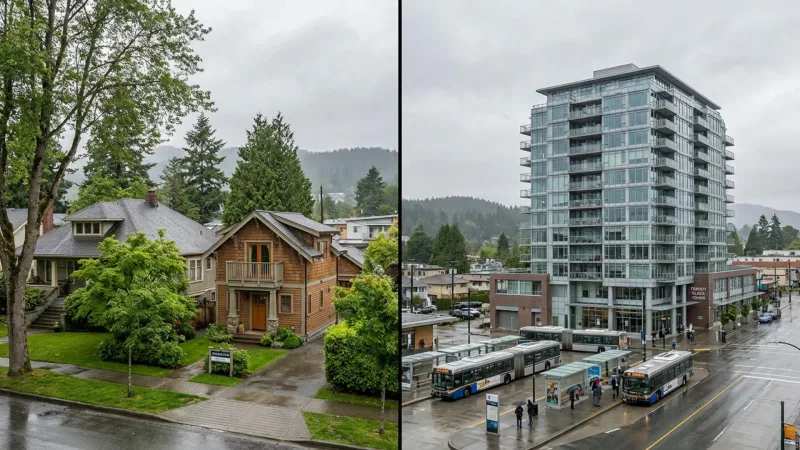
The most obvious difference is the scale of development each framework permits. SSMUH enables gentle density, adding one to five additional units to an existing residential lot. TOAs enable urban-scale density, multi-storey buildings with dozens or hundreds of units. A SSMUH project is typically a homeowner adding a garden suite or converting to a fourplex. A TOA project is typically a developer assembling lots to build a mid-rise residential or mixed-use building.
Development process
Neither SSMUH nor TOA projects require a rezoning application, which eliminates the public hearing process and significantly shortens approval timelines compared to traditional development. However, the practical complexity differs substantially. A SSMUH project (such as building a garden suite) can often be managed by a homeowner working with an architect and a general contractor. A TOA-scale project (a 10-storey apartment building) requires a professional development team including architects, engineers, project managers, and experienced development consultants.
Investment profile
SSMUH development is accessible to individual homeowners and small-scale investors. Building a garden suite or converting a house to a duplex typically costs $200,000 to $500,000. TOA development requires substantially more capital, a mid-rise building near a transit exchange can cost $10 million to $50 million or more. The return profile is correspondingly different: SSMUH projects generate modest rental income, while TOA projects can generate significant development profits but carry higher risk. For TOA projects creating strata-titled units, our strata guide for Victoria BC covers the ownership framework, insurance, and buyer expectations that shape demand.
Density Comparison by Zone
The following table compares the typical density permitted under each framework, showing the significant step-up from SSMUH to TOA:
| Framework | Zone / Tier | Permitted Density |
|---|---|---|
| SSMUH | Small lot (under 280 m²) | Up to 3 units |
| SSMUH | Lot of 280 m² or more | Up to 4 units |
| SSMUH | Near frequent transit (280 m²+) | Up to 6 units |
| TOA | 200–400 m from exchange | Up to 6 storeys (2.5 FAR) |
| TOA | 0–200 m from exchange | Up to 10 storeys (3.5 FAR) |
The density gap between the two frameworks is significant. A large lot under SSMUH can accommodate up to six units near frequent transit. The same lot within 200 metres of a designated transit exchange could support a building of up to 10 storeys with potentially 40 to 80 units. Even in the outer TOA tier (200-400 metres), a 6-storey building with 20 to 40 units is well beyond what SSMUH permits. These are provincial minimums, and municipalities can allow even greater density.
Which Applies to Your Lot?
Determining which framework applies to your property requires knowing two things: whether your lot is within a municipality subject to SSMUH, and whether your lot is within 400 metres of a designated transit exchange.
If your lot is in Victoria, Saanich, Langford, Colwood, Esquimalt, Oak Bay, View Royal, Central Saanich, or Sidney, SSMUH provisions apply. Your permitted density depends on your lot size: lots under 280 square metres qualify for up to three units, and lots of 280 square metres or more qualify for up to four units. Lots near frequent transit may qualify for up to six units.
If your lot is additionally within 400 metres of the UVic Exchange, Uptown Exchange, Royal Oak Exchange, Langford Exchange, Colwood Exchange, View Royal Exchange, or Legislature Exchange, TOA provisions also apply. In that case, the TOA framework takes precedence, potentially allowing much higher density than the baseline SSMUH entitlement.
Rural municipalities outside the urban containment boundary, including North Saanich, Metchosin, and Highlands, are exempt from both SSMUH and TOA requirements. Some housing options such as secondary suites may still be available under local bylaws, but the provincial density frameworks do not apply.
To check the specific development potential of your lot, including which framework applies and what you can build, use the Development Potential tool.
Check your lot's development potential
Use the free Development Potential tool to see whether SSMUH, TOA, or both apply to your specific property in Greater Victoria.
Check Your LotCan SSMUH and TOA Overlap?
Yes. A property can fall within both a SSMUH-qualifying municipality and a Transit-Oriented Area. This happens when a residential lot in an urban municipality is also within 400 metres of a designated transit exchange. In Greater Victoria, this applies to properties near the UVic, Uptown, Royal Oak, Langford, Colwood, View Royal, and Legislature exchanges.
Where both frameworks apply, the TOA provisions take precedence because they permit significantly higher density. The two frameworks are designed to be complementary, not conflicting. Bill 44 (SSMUH) sets a density floor across all urban residential areas. Bill 47 (TOA) raises that floor substantially near transit exchanges. A property owner in a TOA zone can still pursue a SSMUH-scale project (such as a garden suite or fourplex) if they choose, but the TOA framework opens the door to much larger development that would not be possible under SSMUH alone.
In practical terms, the overlap means that properties near transit exchanges have the highest development flexibility in Greater Victoria. They benefit from both the no-rezoning advantages of SSMUH and the enhanced density of TOA, making them particularly attractive for investors and developers.
Investment Implications
SSMUH and TOA affect property values and investment strategy in different ways, and understanding these differences is important for homeowners, investors, and developers.
SSMUH and property values
SSMUH has created a modest but meaningful uplift in values for qualifying residential lots across Greater Victoria. Properties with clear SSMUH development potential, such as lots large enough for a fourplex in desirable neighbourhoods, are commanding premiums over comparable lots without development potential. The value increase is typically 5% to 20% above what the property would be worth as a single-family home alone, reflecting the additional rental income and flexibility that SSMUH units provide.
TOA and property values
TOA designations have a far more dramatic impact on land values. A single-family lot within the inner TOA tier may be worth two to five times its value as a residential-only site, because a developer could build a multi-storey building with dozens of units. Properties closest to designated transit exchanges have seen the largest value increases. However, realizing this value requires either selling to a developer or undertaking a complex, capital-intensive development project.
Strategic considerations
For homeowners in SSMUH areas outside of TOA zones, adding a secondary suite or garden suite is a practical way to increase property income and value. For homeowners within TOA boundaries, the decision is more complex: you can pursue a modest SSMUH project now, or hold the property and potentially sell to a developer at a premium as TOA development demand increases. Consulting with a local REALTOR who understands both frameworks can help you evaluate which approach aligns with your financial goals and timeline.
Frequently Asked Questions
Is SSMUH the same as a Transit-Oriented Area?
No. SSMUH (Small Scale Multi-Unit Housing) and Transit-Oriented Areas (TOAs) are two separate provincial frameworks introduced under different legislation. SSMUH comes from Bill 44 and allows gentle density of up to six units on residential lots across BC. TOAs come from Bill 47 and mandate significantly higher density, up to 10 storeys, on properties within 400 metres of designated transit exchanges. SSMUH applies broadly to residential areas; TOAs apply only within defined distances of specific transit hubs.
Can my property qualify for both SSMUH and TOA?
Yes, it is possible for a property to fall within both frameworks. If your lot is in a municipality subject to SSMUH requirements and is also within 400 metres of a designated transit exchange, both SSMUH and TOA regulations technically apply. In practice, the TOA framework takes precedence because it permits significantly higher density than SSMUH. You would develop under the TOA provisions, which supersede the baseline SSMUH entitlements.
Which gives higher density, SSMUH or TOA?
Transit-Oriented Areas provide dramatically higher density than SSMUH. Under SSMUH, the maximum is up to six units on qualifying lots near frequent transit. Under TOA provisions, properties within 200 metres of a transit exchange may be permitted buildings of up to 10 storeys with a FAR of 3.5, and properties between 200 and 400 metres may allow up to 6 storeys with a FAR of 2.5. The difference in buildable floor area can be tenfold or more.
Do I need to rezone under SSMUH or TOA?
Neither framework requires a traditional rezoning application. Under SSMUH (Bill 44), municipalities must pre-zone to allow the permitted number of units without requiring the property owner to go through a rezoning process. Under TOA (Bill 47), municipalities must similarly update their zoning bylaws to accommodate the mandated density near transit exchanges. In both cases, qualifying projects proceed directly to building permit without a public hearing or rezoning.
Which Greater Victoria areas have Transit-Oriented Areas?
Seven Greater Victoria transit exchanges are designated under TOA legislation: UVic Exchange (Saanich), Uptown Exchange (Saanich), Royal Oak Exchange (Saanich), Langford Exchange, Colwood Exchange, View Royal Exchange, and Legislature Exchange (downtown Victoria). TOA boundaries extend 400 metres from each designated exchange, with two density tiers (within 200m and 200-400m).
Can I build a fourplex in a Transit-Oriented Area?
Yes, and you can likely build much more than a fourplex. A fourplex is a common SSMUH configuration for larger lots, but TOA regulations permit substantially greater density. Within 200 metres of an exchange, buildings of up to 10 storeys are permitted. Between 200 and 400 metres, buildings of up to 6 storeys are permitted. A fourplex would be well below the maximum density allowed in any TOA zone.
What is the difference between Bill 44 and Bill 47?
Bill 44 is the Housing Statutes Amendment Act, which establishes SSMUH requirements for gentle density (up to six units) on residential lots across all qualifying municipalities in BC. Bill 47 is the Housing Statutes (Transit-Oriented Areas) Amendment Act, which mandates higher-density development near designated transit exchanges. Bill 44 provides a baseline density floor across urban areas; Bill 47 provides enhanced density near transit hubs. Both were passed as part of BC's comprehensive housing legislation package in November 2023.
Should I develop under SSMUH or wait for TOA zoning?
This depends on your property's location. If your lot is not within 400 metres of a designated transit exchange, TOA provisions do not apply, and SSMUH is your pathway. If your lot is within a TOA boundary, you may benefit from the higher density permitted under Bill 47, but TOA-scale development typically requires a larger investment, professional development team, and longer timeline. For homeowners looking to add a suite or build a fourplex, SSMUH is the practical near-term option. For landowners considering larger multi-storey projects near transit, TOA regulations may offer greater value.
How do parking rules differ between SSMUH and TOA?
Both frameworks reduce parking requirements compared to traditional zoning, but TOA rules are more aggressive. Under SSMUH, municipalities generally cannot require more than one parking space per unit, and requirements are further reduced near frequent transit routes. Under TOA, municipalities cannot impose any minimum residential parking requirements at all, except for accessible parking. This elimination of parking minimums is one of the most significant provisions of Bill 47 and dramatically changes the economics of development near transit exchanges.
Does TOA density apply to all property types near transit?
TOA density requirements generally apply to residential and mixed-use zoned properties within 400 metres of designated transit exchanges. However, limited exemptions exist for properties with environmental constraints such as floodplains and environmentally sensitive areas, heritage-designated buildings, Agricultural Land Reserve lands, and areas where servicing infrastructure is fundamentally inadequate. The province has stated that exemptions are intended to be narrow and site-specific, not area-wide.