Overview of the Development Team
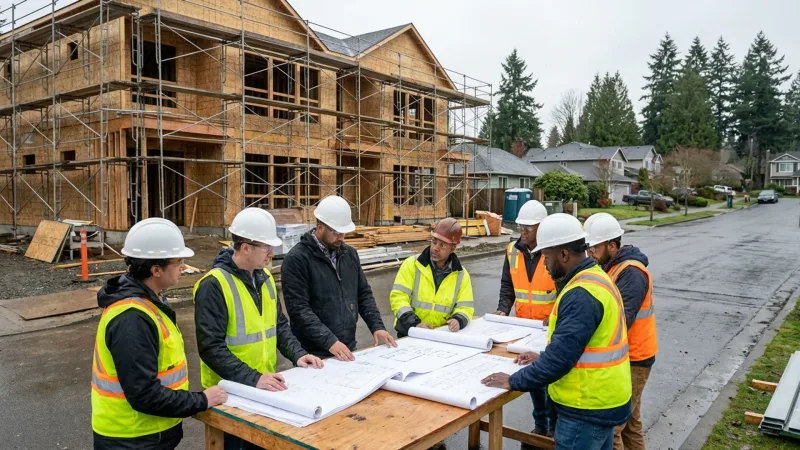
Residential development in British Columbia requires a coordinated team of specialized professionals. Whether you are building a garden suite under SSMUH or a mid-rise building in a Transit-Oriented Area, the quality of your consulting team directly determines the success of your project, from the accuracy of your initial feasibility analysis to the efficiency of your permit approval and the quality of the finished construction.
Each consultant plays a distinct role, and their work products feed into each other in a specific sequence. The land surveyor provides the foundational data that the architect uses to design the building. The architect's design informs the structural engineer's calculations, the civil engineer's servicing plan, and the landscape architect's site design. Understanding these dependencies helps you hire the right professionals in the right order and avoid costly rework.
The 10 key professionals described in this guide cover the disciplines most commonly required for residential development in Greater Victoria and across Vancouver Island. Not every project needs all 10, but understanding what each consultant does helps you identify which ones are essential for your specific site and project type. A preliminary assessment of your site's development potential will help determine which consultants to engage first.
The 10 Key Professionals
Below is a summary of each consultant, their role in the development process, and a link to the detailed deep-dive guide for each discipline.
BC Land Surveyor (BCLS)
The land surveyor establishes legal boundaries and creates the topographic survey that every other consultant needs. They produce boundary surveys, topographic surveys, subdivision plans, and strata plans. Always the first professional to engage.
Certified Arborist
Arborists assess trees on and near the development site, produce tree management plans required by municipal tree protection bylaws, and advise on Garry Oak and other protected species. Required early if significant trees are present.
Geotechnical Engineer
Geotechnical engineers assess soil conditions, slope stability, seismic risk, and groundwater. Their reports inform foundation design and determine whether additional site preparation is needed. Critical for sloped lots and areas with challenging soils.
Building Architect (AIBC)
Architects design the building and coordinate the overall design team. For Part 9 buildings (most SSMUH projects), a qualified building designer may suffice. Part 3 buildings (over three storeys or five-plus units) require a registered AIBC architect.
Structural Engineer
Structural engineers design the building's structural system to resist gravity loads, seismic forces, and wind loads. Vancouver Island's high seismic zone makes structural engineering particularly critical. Required for all multi-unit buildings.
Civil Engineer
Civil engineers design the infrastructure that connects the building to municipal services: sanitary sewer, storm drainage, water supply, and road access. They also prepare servicing agreements and Development Cost Charge calculations.
Building Envelope Consultant + Energy Advisor
Envelope consultants ensure the building is weathertight in Vancouver Island's high-rainfall climate. Energy advisors verify compliance with BC's Energy Step Code. Both are increasingly required for building permits in Greater Victoria.
Landscape Architect (BCSLA)
Landscape architects design everything outside the building footprint: grading, stormwater management, outdoor living spaces, planting plans, and Development Permit compliance. Required for projects that trigger Development Permit Area guidelines.
Environmental Consultant (QEP)
Qualified Environmental Professionals assess riparian areas, species at risk, contaminated sites, and other environmental factors that affect development. Required when the site is near watercourses, wetlands, or known contamination.
Traffic Engineer
Traffic engineers prepare traffic impact assessments, parking studies, and access designs. Required for larger projects or when municipal staff identify traffic concerns. Increasingly relevant for TOA and multi-unit SSMUH projects.
Hiring Order & Dependencies
The order in which you engage consultants matters because each professional's work depends on outputs from earlier stages. Here is the recommended sequence:
Phase 1: Site assessment (weeks 1–4)
- BC Land Surveyor: Commission the topographic and boundary survey first. Every other consultant needs this data.
- Geotechnical engineer: If the site has slopes, rock, or suspected soil issues, engage the geotech concurrently with or immediately after the survey.
- Arborist: If significant trees are present, the arborist assessment should happen early so that tree protection requirements can inform the building design.
- Environmental consultant: If the site is near watercourses, wetlands, or has potential contamination, engage the QEP early to identify setbacks and restrictions.
Phase 2: Design (weeks 4–12)
- Architect / building designer: With survey data, geotech results, and environmental constraints in hand, the architect designs the building and site plan.
- Structural engineer: Works from the architect's design to produce structural drawings and calculations.
- Civil engineer: Designs servicing connections (sewer, water, stormwater) based on the site plan.
- Landscape architect: Designs outdoor spaces, grading, and drainage in coordination with the civil engineer and architect.
Phase 3: Compliance and optimization (weeks 8–16)
- Building envelope consultant + energy advisor: Reviews the building design for weather-tightness and Step Code compliance.
- Traffic engineer: Prepares traffic impact assessment or parking study if required by the municipality.
These phases overlap. Your architect will begin preliminary design while geotechnical and environmental work is underway, and engineering disciplines often work concurrently once the design concept is established. Effective project coordination ensures that information flows smoothly between consultants and that no discipline is waiting on another.
Cost Ranges
Total consulting costs vary significantly by project type and complexity. Here are representative ranges for common project types in Greater Victoria:
Garden suite (SSMUH)
A typical garden suite on a flat, serviced lot requires a land survey ($3,000–$5,000), building design ($8,000–$15,000), structural engineering ($3,000–$6,000), and possibly a geotechnical report ($3,000–$5,000). Total consulting fees: $15,000 to $35,000.
Fourplex (SSMUH)
A fourplex adds complexity with civil engineering for servicing ($5,000–$12,000), a more detailed architectural design ($15,000–$30,000), envelope and energy consulting ($3,000–$8,000), and potentially landscape architecture ($5,000–$10,000). Total consulting fees: $30,000 to $60,000.
Multi-unit TOA project
A mid-rise project in a Transit-Oriented Area requires the full consulting team including a registered architect ($40,000–$80,000+), multiple engineering disciplines ($30,000–$60,000), and specialized consultants like traffic engineers and environmental professionals. Total consulting fees: $80,000 to $200,000+.
Subdivision
Subdividing a large lot requires a BCLS to prepare the subdivision plan ($5,000–$15,000), civil engineering for servicing ($10,000–$25,000), and potentially geotechnical, environmental, and arborist assessments for each resulting lot. Total consulting fees: $25,000 to $75,000.
SSMUH vs Full Development Projects
The consulting requirements differ significantly between SSMUH projects and larger developments:
SSMUH projects (2–4 units)
SSMUH projects (Secondary Suites, Mortgage Helper suites, and Fourplexes) are enabled by Bill 44, provincial legislation that allows increased density on residential lots. These projects have distinct consulting requirements:
- Typically Part 9 under the BC Building Code (buildings not exceeding three storeys and 600 square metres).
- Can be designed by a qualified building designer rather than a registered architect.
- Simpler structural and mechanical systems.
- Usually do not trigger a Development Permit, reducing the number of required consultants.
- Municipal building permit review is typically 8 to 16 weeks.
- Total consulting budget: $15,000 to $60,000.
Larger development projects (5+ units)
- Part 3 under the BC Building Code (over three storeys or over 600 square metres).
- Require a registered AIBC architect and Letters of Assurance from all engineering disciplines.
- More complex structural, mechanical, and electrical systems.
- Often require Development Permits with landscape and urban design review.
- May require traffic impact assessments, detailed environmental studies, and public consultation.
- Municipal review timelines can be 6 to 12 months or more.
- Total consulting budget: $80,000 to $200,000+.
Understanding which category your project falls into is essential for budgeting and timeline planning. Your architect or building designer can confirm the applicable Building Code classification early in the process.
How to Find Qualified Consultants
Finding the right consultants is as important as knowing which ones you need. Here are practical approaches for finding qualified professionals on Vancouver Island:
Professional associations
- ABCLS (Association of BC Land Surveyors) maintains a directory of licensed land surveyors.
- AIBC (Architectural Institute of BC) has a searchable directory of registered architects.
- EGBC (Engineers and Geoscientists BC) registers all practicing engineers in the province.
- BCSLA (BC Society of Landscape Architects) lists registered landscape architects.
- ISA (International Society of Arboriculture) and RCA (Registered Consulting Arborists) credential arborists.
Municipal referrals
Municipal planning departments work with consultants regularly and can often suggest firms that are familiar with local requirements and produce high-quality work. Pre-application consultations are a good opportunity to ask for recommendations.
Developer and REALTOR networks
Experienced developers and REALTORS who work with development properties maintain networks of trusted consultants. These referrals are valuable because they come from professionals who have seen the consultants' work product and know which firms deliver on time and within budget.
Key selection criteria
- Local experience: Consultants who work regularly in your municipality understand local bylaw nuances, staff expectations, and common site conditions.
- Relevant project experience: A consultant who has designed garden suites in Victoria will be more efficient than one who primarily works on commercial buildings in Vancouver.
- Responsiveness: Development projects involve tight deadlines and coordination between multiple parties. Choose consultants who communicate clearly and meet commitments.
- References: Ask for references from recent projects of similar scope and type. Follow up with those references.
Frequently Asked Questions
Do I need all 10 consultants for every development project?
No. The number of consultants you need depends on the complexity and scale of your project. A straightforward SSMUH project such as a garden suite on a flat, serviced lot may only require a land surveyor, architect or building designer, and structural engineer. A fourplex on a sloped lot near a watercourse could require eight or more. Larger TOA projects or subdivisions typically need the full team. Your architect and municipality can help identify which disciplines are required for your specific site and project.
What order should I hire development consultants?
The land surveyor should always be first. Their topographic and boundary survey provides the foundational data that every other consultant needs. After the survey, engage the architect or building designer to develop the site plan and building design. Once the design concept is established, bring in the structural engineer, geotechnical engineer (if needed), and civil engineer. Environmental consultants and arborists should be engaged early if there are known environmental constraints. The building envelope consultant and traffic engineer typically come later in the design process.
What are typical total consultant costs for a development project?
For a simple SSMUH project like a garden suite, total consulting fees are typically $15,000 to $35,000 including survey, design, and engineering. A fourplex project on a straightforward site runs $30,000 to $60,000. A larger multi-unit project or TOA development can cost $80,000 to $200,000 or more in consulting fees, depending on the number of disciplines required and the complexity of the site. These are fees paid to consultants only and do not include municipal permit fees or construction costs.
How do SSMUH projects differ from larger developments in terms of consultants needed?
SSMUH projects (secondary suites, garden suites, duplexes, fourplexes) are typically classified as Part 9 buildings under the BC Building Code, which means they can be designed by a building designer rather than a registered architect. They require fewer engineering disciplines and simpler reports. Larger developments (five or more units, buildings over three storeys) are Part 3 buildings that require a registered AIBC architect, more extensive structural and mechanical engineering, and often additional consultants such as traffic engineers and building envelope specialists.
Who should I hire first for a development project?
Always start with a BC Land Surveyor (BCLS). The topographic survey establishes the legal boundaries of your lot, identifies easements, and maps the existing conditions including elevations, trees, and structures. This information is essential for every other consultant. Without a current survey, your architect cannot produce accurate drawings, your civil engineer cannot design servicing, and your geotechnical engineer cannot properly locate their test holes. The survey is the foundation that everything else builds on.
How long does the consulting and design phase take?
For a straightforward SSMUH project, the consulting and design phase typically takes 2 to 4 months from initial survey to submission of a building permit application. A more complex project with multiple engineering disciplines can take 4 to 8 months. Large TOA or subdivision projects may require 6 to 12 months of design work before a permit application is ready. These timelines assume consultants are available and responsive; during busy periods, getting a survey or geotechnical investigation scheduled can add weeks to the timeline.
Can one firm handle multiple consulting roles?
Some larger engineering firms offer multiple disciplines under one roof, such as civil, structural, and geotechnical engineering. This can simplify coordination and sometimes reduce costs. However, most development projects require at minimum three to four separate firms because the disciplines are specialized. The land survey must be done by a licensed BCLS, architecture by an AIBC architect or qualified building designer, and environmental assessments by a Qualified Environmental Professional (QEP). Even within engineering, the structural, civil, and geotechnical disciplines are distinct specializations.
Do I need a project manager for my development project?
For simple SSMUH projects, the architect or building designer often serves as the de facto project coordinator during the design phase. For larger projects, a dedicated project manager or development consultant can be invaluable for coordinating multiple consultants, managing timelines, and ensuring that submissions to the municipality are complete and coordinated. Some REALTORS who specialize in development properties also provide project coordination services for clients navigating their first development project.
What happens if I skip a required consultant?
Skipping a required consultant will result in an incomplete permit application, which the municipality will either reject or return with a request for additional information. This delays the project and may require redesign if the missing information reveals constraints that were not accounted for in the original design. For example, skipping a geotechnical assessment on a sloped lot could result in an approved foundation design that fails during construction, leading to costly change orders and delays.
How do I know which consultants my municipality requires?
Each municipality publishes a checklist of required submission materials for building permits. These checklists specify which professional reports and drawings are needed. Your municipality's planning department can also provide guidance during a pre-application consultation, which most Greater Victoria municipalities offer at no charge. The architect or building designer you hire will typically be familiar with local requirements and can advise you on which consultants are needed for your specific project and site.
Can I use out-of-province consultants?
Some disciplines require provincial licensing. The land survey must be performed by a BC Land Surveyor (BCLS) licensed in British Columbia. Architects must be registered with AIBC or work under the supervision of an AIBC member. Engineers must be registered with Engineers and Geoscientists BC (EGBC). Environmental assessments should be prepared by a Qualified Environmental Professional recognized in BC. Using locally experienced professionals is strongly recommended even for disciplines that do not require provincial licensing, because familiarity with local soil conditions, municipal requirements, and regional building practices directly affects the quality and efficiency of their work.