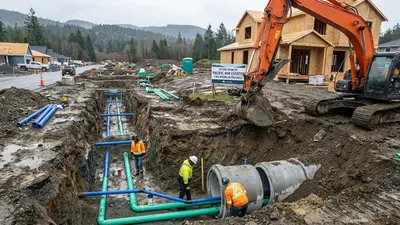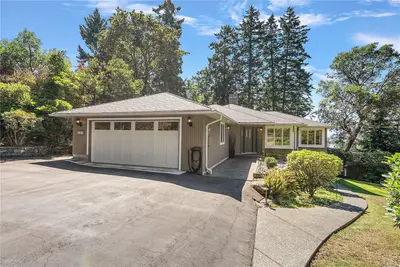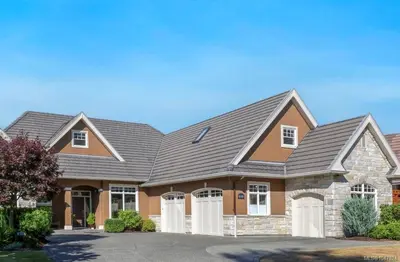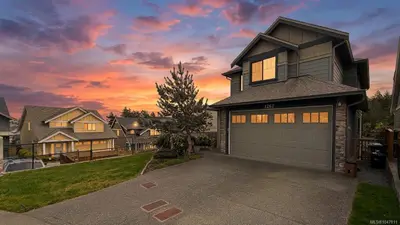
Traffic engineering for residential development has changed dramatically in BC. The traditional focus — how many parking spots do we need and how do cars get in and out? — is being transformed by SSMUH legislation, Transit-Oriented Area designations, and municipal policies that are actively reducing parking requirements. Today's traffic engineer helps developers navigate a system in transition, where proving you need less parking can be as important as designing for adequate traffic flow.
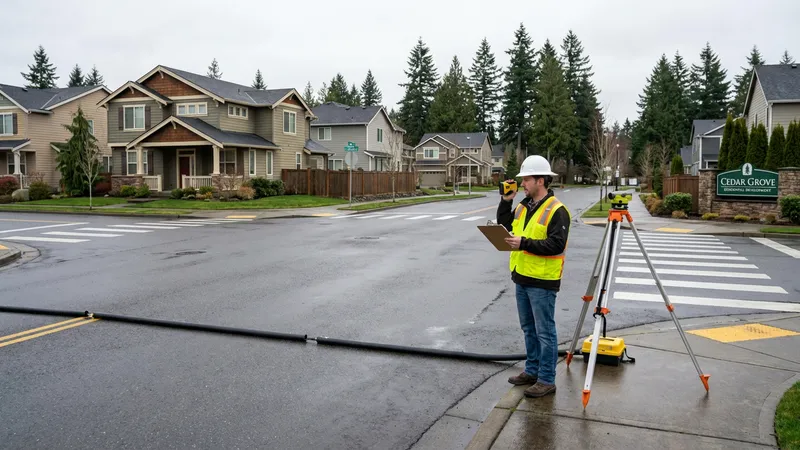
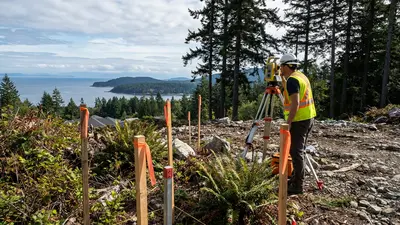
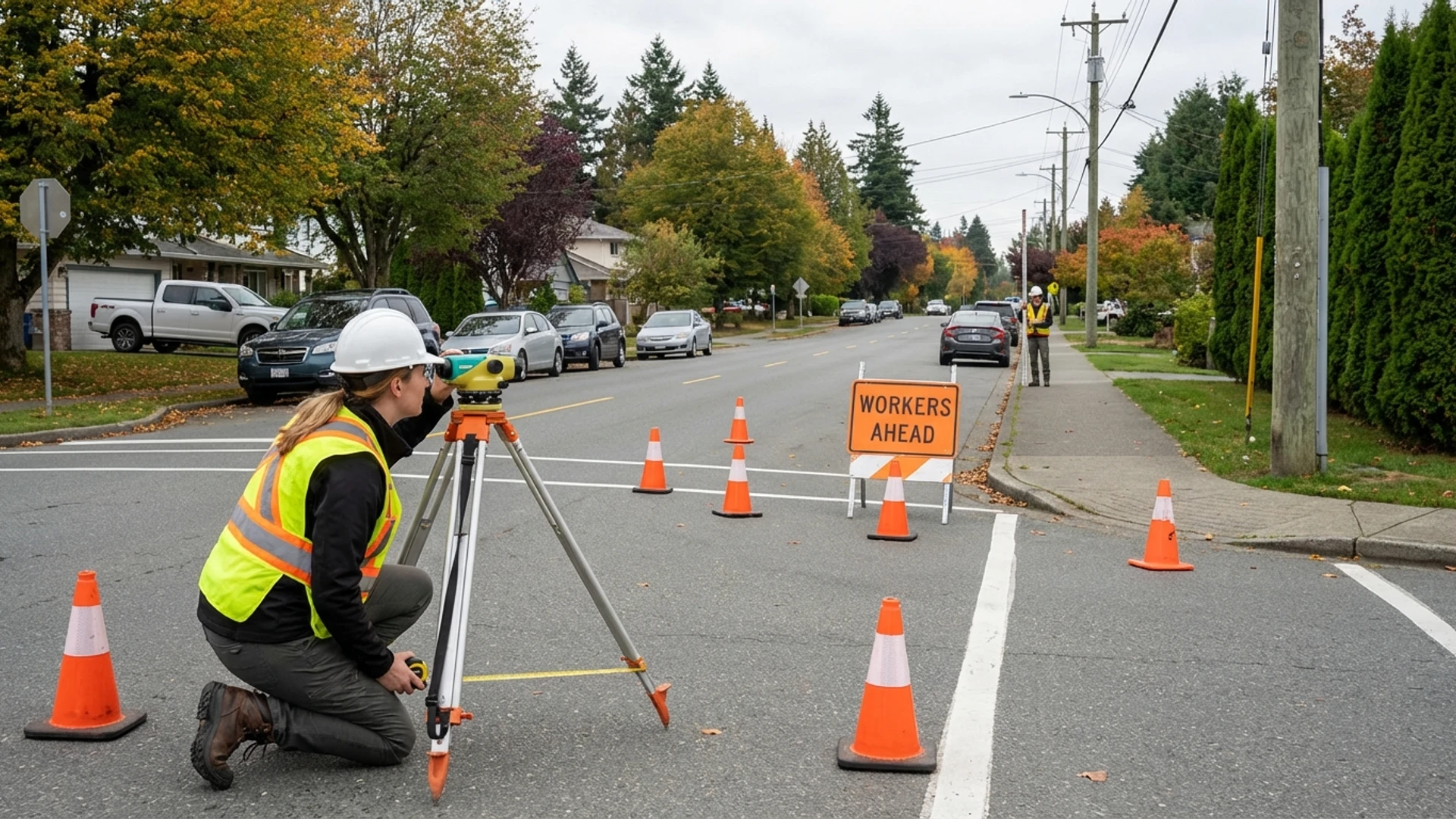
A traffic engineer conducting a sight line and intersection assessment near a residential development site.
When Is a Traffic Impact Assessment Required?
Most BC municipalities have thresholds that trigger a Traffic Impact Assessment (TIA) requirement. While thresholds vary, the most common triggers include:
- Trip generation thresholds: Projects expected to generate more than 50 vehicle trips per day (roughly equivalent to 10+ dwelling units) typically require a TIA
- Rezoning applications: Most rezoning applications that increase density require some level of traffic analysis, even if below the formal TIA threshold
- Subdivision of 4+ lots: Creating multiple new lots triggers traffic review to assess access, intersection impacts, and road capacity
- Municipal referral: Even when formal thresholds aren't met, municipal engineering departments may request traffic analysis based on site-specific concerns (narrow road, school zone, high-accident intersection)
- Provincial highway access: Properties with access to provincial highways (Trans-Canada Highway, Pat Bay Highway) require Ministry of Transportation and Infrastructure (MOTI) referral regardless of project size
Parking Studies: The New Battleground
Parking studies have become one of the most consequential traffic engineering services for Vancouver Island development projects. Under SSMUH and Transit-Oriented Area legislation, municipalities are reducing or eliminating minimum parking requirements. This creates both opportunities and challenges for developers.
The opportunity: Reduced parking means more of the site can be dedicated to housing units, green space, or stormwater management. For tight urban lots in Victoria, Oak Bay, or Esquimalt, eliminating one parking stall can free up 25–30 m² of site area — potentially the difference between a project that works and one that doesn't.
The challenge: Municipalities and neighbours often resist reduced parking, citing on-street parking impacts. A parking study provides evidence-based analysis to support a reduced parking proposal. It documents transit access, walkability, car ownership rates in comparable developments, and on-street parking capacity in the surrounding area.
Trip Generation Analysis
Trip generation analysis estimates how many vehicle trips a proposed development will add to the surrounding road network. Traffic engineers use the Institute of Transportation Engineers (ITE) Trip Generation Manual, which provides rates based on land use type, building size, and number of dwelling units.
However, ITE rates were developed primarily from suburban American development patterns. They may overestimate trips for well-located urban projects on Vancouver Island. A skilled traffic engineer will apply local adjustment factors based on transit access, walking and cycling infrastructure, and the specific characteristics of the site and surrounding neighbourhood.
Sight Line Assessments
Every new driveway must provide adequate sight lines for drivers exiting onto the road. The traffic engineer assesses whether drivers can see approaching traffic, pedestrians, and cyclists in sufficient time to safely enter the roadway. This involves measuring sight triangles based on the road's posted speed, grade, curvature, and expected traffic volumes.
On Vancouver Island, sight line issues commonly arise with:
- Steep driveways: Hillside properties where the driveway grade limits the driver's view of the road
- Narrow lots: Properties in older Victoria and Oak Bay neighbourhoods where lot width constrains driveway placement
- Vegetation and fencing: Existing hedges, fences, or retaining walls that obstruct sight lines; the traffic engineer identifies what must be modified
- Curved roads: Properties on the inside of road curves where sight distance is naturally limited
Pedestrian and Cycling Access
BC's Active Transportation policies increasingly require that development projects address pedestrian and cycling access — not just vehicle traffic. The traffic engineer assesses how residents and visitors will access the site on foot and by bicycle, including connections to existing sidewalks, cycling infrastructure, and transit stops.
For multi-unit developments, bicycle parking requirements are now standard in most Vancouver Island municipalities. The traffic engineer helps determine the appropriate number and type of bicycle parking spaces — long-term secure storage for residents versus short-term visitor parking — and their location on the site.
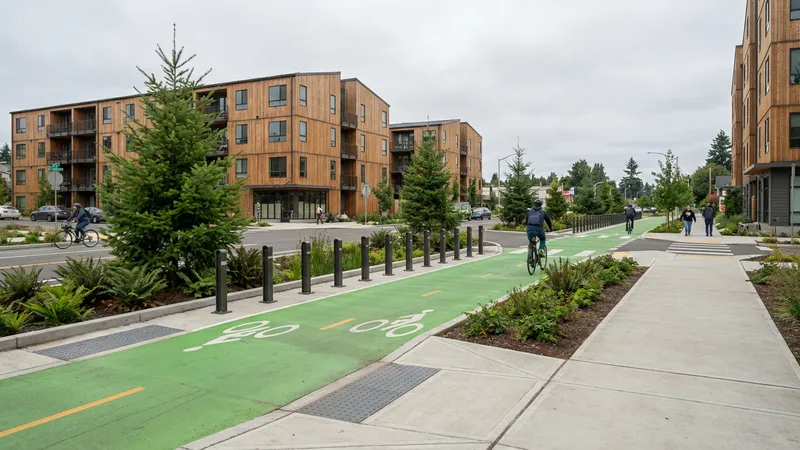
Modern pedestrian and cycling infrastructure at a multi-unit development, with a protected bike lane, accessible sidewalks, and native landscaping.
Municipal Referral Process
Development applications on Vancouver Island typically go through a municipal referral process where the engineering department reviews traffic impacts. The traffic engineer prepares the analysis required to satisfy this referral, which may range from a simple trip generation letter for small projects to a comprehensive TIA for larger developments.
Early communication with the municipal engineering department helps identify the scope of traffic analysis required. Some municipalities have pre-application processes where you can confirm what level of study is needed before investing in a full TIA.
Vancouver Island Specifics
Narrow Lots in Older Neighbourhoods
Many properties in Victoria, Oak Bay, and Esquimalt were subdivided over a century ago with frontages of 10–15 metres. These widths make modern driveway design challenging. Adding multiple dwelling units under SSMUH while providing safe vehicle access on a narrow lot requires creative traffic engineering solutions, including shared driveways, rear lane access, and alternative parking configurations. See our development potential assessment guide to evaluate access and parking constraints on your property. The traffic engineer is the final member of the ten-person development consultant team.
Rural Highway Access
Properties fronting provincial highways — the Trans-Canada Highway through Langford and Colwood, the Pat Bay Highway through Central and North Saanich, and Highway 14 to Sooke — require Ministry of Transportation and Infrastructure (MOTI) approval for any new or modified access. MOTI has its own standards for sight lines, acceleration/deceleration lanes, and access spacing that are separate from — and often more stringent than — municipal requirements.
SSMUH and TOA Context
BC's SSMUH legislation and Transit-Oriented Area designations are fundamentally changing traffic engineering for residential development. Reduced parking minimums mean traffic engineers are increasingly asked to justify lower parking ratios rather than simply meeting minimum standards.
This requires a more nuanced understanding of transportation behaviour — transit ridership, car-sharing, cycling rates, and walk scores — than traditional traffic engineering approaches.
Typical Costs on Vancouver Island
| Service Type | Typical Cost Range |
|---|---|
| Parking study | $3,000–$8,000 |
| Sight line assessment | $1,500–$3,000 |
| Trip generation letter | $2,000–$5,000 |
| Full Traffic Impact Assessment | $8,000–$25,000+ |
Costs depend on the scope of analysis, number of intersections studied, data collection requirements (traffic counts are a significant cost component), and the complexity of the transportation network around the site. Full TIAs for larger projects with multiple intersection analyses are at the higher end.
How to Choose a Traffic Engineer
- Verify P.Eng. registration: Confirm registration through the EGBC registrant directory
- Municipal experience: A traffic engineer who has worked with your municipality's engineering department and understands their standards and expectations will produce more effective studies
- SSMUH and parking reduction experience: As parking requirements evolve, choose an engineer experienced with evidence-based parking reduction studies, not just traditional TIA work
- Multi-modal expertise: Modern traffic engineering increasingly requires analysis of pedestrian, cycling, and transit access, not just vehicle movements. Look for engineers with multi-modal transportation planning experience
Check Your Property's Development Potential
Understanding your property's development potential helps scope traffic engineering needs. Our free Development Potential Assessment analyzes your Vancouver Island property against SSMUH, TOA, and subdivision regulations.
Start Your AssessmentThe Complete Consultant Guide Series
- Overview: Building Your Development Team
- Part 1: BC Land Surveyor (BCLS)
- Part 2: Certified Arborist
- Part 3: Geotechnical Engineer
- Part 4: Building Architect (AIBC)
- Part 5: Structural Engineer
- Part 6: Civil Engineer
- Part 7: Building Envelope Consultant + Energy Advisor
- Part 8: Landscape Architect (BCSLA)
- Part 9: Environmental Consultant (QEP)
- Part 10: Traffic Engineer — You Are Here
Disclaimer: This article provides general information about traffic engineering for development in BC as of February 2026. Municipal requirements and thresholds vary. Always confirm specific requirements with your local engineering department and the Ministry of Transportation and Infrastructure for properties on provincial highways. This is not legal or professional advice.